
Route a Lee County Warrant Record Request
A Lee County warrant record request works best when it names the exact record you want. The clerk of the issuing court holds the warrant order and docket history. The sheriff may hold a return, custody, or service record instead. Asking one office for everything, with no record named, invites delays and incomplete answers. So state the warrant type, the issuing court, the approximate date, the case or citation number, and the public portion you seek. If the office that receives the request lacks administrative control of the record, ask it to identify the proper custodian. Leave ACIC and NCIC printouts out of the request. Those systems are restricted, and Arkansas FOIA does not turn them into public records.
How to Search for a Warrant in Lee County
No single public system lists every Lee County warrant. Start from the paper or event that raised the concern, then pull the public court file and call the court that owns the case. For traffic, misdemeanor, ordinance, and city-department matters, the Lee County District Court Clerk is the usual first stop. Circuit criminal records go to the Circuit Clerk.
- Collect the full legal name, date of birth, case number, citation number, and prior date if known.
- Use Search ARCourts by participant or case number.
- Read all warrant, bond, service, recall, and closure events in date order.
- Call the issuing clerk, then the sheriff or jail for service, surrender, or custody questions.
- Use a specific FOIA request if a public record remains missing or unclear.
The Lee County sheriff page posts no public search box. ACIC keeps a Wanted Person File, but the public cannot reach it, and FOIA will not open it.
Search ARCourts Routes for Lee County Warrants
The Arkansas Judiciary presents Search ARCourts as public case information for the courts on its case system, not as a warrant list for Lee County. Two routes in. The participant route helps when no case number is known. The case route is sharper once paperwork supplies an identifier. Advanced search and filters narrow the field, but a narrow result still needs status confirmation from the court. The official navigation tips explain the difference between participant and case searches. Type the legal spelling shown on court papers, and try the middle name when a common name returns several candidates. Match the court, case type, filing date, and offense before treating a result as the right person. The portal transition is laid out in the Arkansas Judiciary overview, which describes the portal as a case-information source rather than a live list of every outstanding warrant.
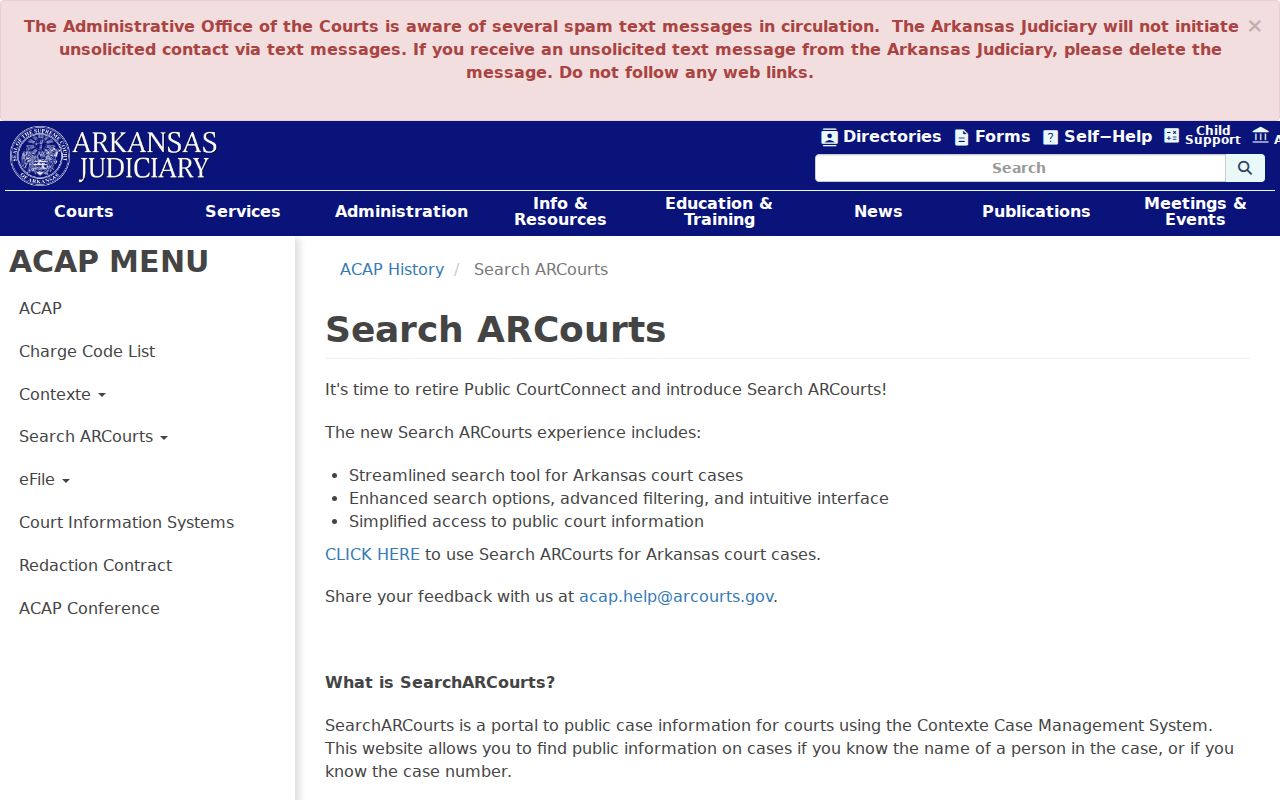
The ARCourts portal overview for Lee County describes a case-information source, not a complete live warrant list.
Lee County Warrant Search Fields
Search ARCourts offers both a name route and a case route for a Lee County warrant search. The public interface and the official guidance display the fields below. Treat some as optional. The new interface may adjust its filters, so trust the labels on screen over any assumed format.
| Field or Control | Type | Use |
|---|---|---|
| First Name | Text | Legal first name for participant search |
| Middle Name | Text | Useful for narrowing common names |
| Last Name | Text | Participant surname |
| Organization or Case Description | Text | Alternate party or description route |
| Case Number | Text | Direct case search where known |
| Advanced Search | Control | Additional criteria in the current interface |
| Filter Options | Control | Narrows available public results |
Lee County's district plan uses AW and SW warrant-docket prefixes. Enter only an identifier that appears on court paperwork or comes from the clerk.
Common Names in a Lee County Warrant Search
A name match is a lead, not proof of identity. Check the middle name, date of birth when the office will share it, case location, role, filing date, citation, and charge. Search ARCourts does not expose every identifying detail to the public view of a Lee County warrant file, so never rely on first and last name alone.
Search carefully: Give private identifiers only to an official court or agency through a confirmed channel, and ask the clerk to verify the correct case.
Still seeing several names? Try the exact case or citation number. If nothing comes back, fix the spelling first. Then ask whether the matter sits in Lee County district court, circuit court, another jurisdiction, or a restricted file.
What a Lee County Warrant Search Returns
A public Lee County court result can list a warrant event among many other case events. You might see issuance, later service, a bond order, forfeiture, a suspension notice, or closure. The newest line on the screen may not reflect the live law-enforcement record.
| Case identity | Case number, title, participant names and roles, judge, and filing date. |
|---|---|
| Offense details | Charge, citation, statute, offense date, level, plea, and disposition. |
| Docket event | Date and description such as arrest warrant issued, served, bench warrant, or FTA. |
| Bond information | Bond set, cash, surety, professional bond, forfeiture, or no-bond text where public. |
| Future action | Scheduled event, filing, public document indicator, or judgment. |
| Later status | Service, recall, quash, transfer, disposition, or case closure may follow issuance. |
Lee County publishes no official warrant count and no local bond schedule. Read each search result case by case.
Why No Result Does Not Clear a Lee County Warrant
A blank Lee County search can mean several things. The name may have been entered differently, or the warrant was just issued. You may have searched the wrong court. The file could be sealed or confidential, or the public portal simply may not display what the court holds. Search ARCourts is not the sheriff's service system, and it is not the ACIC Wanted Person File. Administrative Order 19 shields confidential material and personal identifiers. Arkansas law can close juvenile records, and search-warrant applications tied to an open investigation may be restricted too. Those limits serve lawful privacy. Still, absence from public results is not a clearance document.
Note: Confirm a no-result with the likely issuing clerk and sheriff when the inquiry concerns an expected Lee County warrant event.
Where Lee County Warrants Are Checked
Each Lee County office answers a different piece of the question. The issuing court knows what it issued and whether it later recalled or quashed the order. The clerk keeps the public file. The sheriff or another officer receives and serves process. Public court search supports that work but never merges all three roles.
| Channel | Best Question | Lee County Route |
|---|---|---|
| District Court Clerk | Traffic, misdemeanor, city, FTA, payment-plan, or preliminary-felony case | (870) 295-7730 directory listing |
| Circuit Clerk | Felony criminal file, circuit appearance, or circuit warrant event | (870) 295-7710 |
| Sheriff or jail | Service, custody, surrender, or jail procedure | (870) 295-7775 association directory |
| Search ARCourts | Available public case chronology | Participant or case search |
| ACIC | Authorized criminal-justice use only | No public search or FOIA access |
All three Lee County offices operate from the courthouse at 15 E. Chestnut Street in Marianna. Call before you drive over, since no warrant-counter or walk-in procedure is published.
AW and SW in Lee County Search Results
Lee County's criminal warrant docket comes under a district administrative plan with two sections. AW means arrest warrant. SW means search warrant. A returned warrant can sit there before any criminal file opens, then move into the case if charges follow, so the clerk may need to trace the earlier warrant-docket entry. That is why a case search may miss it.
- AW docket
- The local arrest-warrant docket prefix, not proof of a specific active status.
- SW docket
- The local search-warrant docket prefix, not a public name-search function.
- Served
- An officer executed the warrant; a later case event may still need review.
- Returned
- The agency returned the order to court as executed or unexecuted.
- Quashed
- The court set aside the warrant through judicial action.
Ask the clerk for the exact description and any later events. A Lee County AW entry may carry docket detail on a bench warrant or a failure to appear.
Access and Restricted Warrants
Lee County warrant records sit under two rule sets. Agency records answer to Arkansas FOIA, which permits specific requests by any method the custodian accepts. Court records follow Arkansas Supreme Court Administrative Order 19. Neither route opens ACIC or NCIC data to the public.
Access rule: Request the public portion from the office that controls it and ask for the exemption or correct custodian when material is withheld.
The Attorney General's FOIA overview sets the outer limits: agencies generally get up to three business days and may charge actual reproduction plus mailing costs. Lee County posts no set warrant-search or certified-copy fee. So ask the custodian first. Keep the request narrow enough to locate one record rather than a broad private-name roster.
FOIA Fallback for a Lee County Warrant Search
Sometimes the portal and the calls both fail. A focused FOIA request can answer a stubborn Lee County warrant question. Address it to the right custodian. A warrant or docket entry from a Lee County court belongs with the clerk of that court. Sheriff execution or service records belong with the sheriff. Say the request concerns your own record or a relative's identified matter. Give the case number if you have one. Ask for the public portion of the specific warrant, FTA, bench, arrest-warrant, or service record, its issuing court, and the correct custodian if that office does not hold it. Arkansas FOIA accepts in-person, telephone, mail, fax, email, or another electronic method the custodian offers, so confirm the destination before sending birth dates or identity documents. Compiled judiciary data runs through the Arkansas Judiciary data-request page, which applies Administrative Order 19. A routine status check still starts with the clerk.